
7. Children And Adolescents: Body And Mind Grow Together
If a child has trouble breathing, altered consciousness, seizures, serious injury, clear dehydration, severe pain, self-harm or suicide risk, risk of being harmed, or severe mental or behavioral changes, call emergency services, go to an emergency department, or contact local crisis or professional support promptly. This page helps families understand body and mental changes, organize information, and choose care or support entry points. It does not diagnose.
Some health problems are heavy and clear, and they often need the medical system to take over quickly. Children's problems often look different: many things are not clear at the beginning, but they happen at home every day.
A child says their stomach hurts in the morning and does not want to go to school. At night they cannot stop scrolling, and the next day they cannot get up. A teen becomes sensitive about periods, acne, and body shape. Another teen suddenly stops talking, talks back, stays up late, and closes the door. Grades drop, and the parent's first reaction is school attitude, while the child cannot clearly say what is wrong.
When these scenes appear, adults easily grab an explanation immediately: the phone did it, school pressure is too high, this is puberty, pretending to be sick, laziness, poor judgment, mental health problem.
These explanations sometimes touch part of the truth, but they are often too fast. A too-fast explanation makes parents and caregivers miss the more important questions: is the child's body in danger? Has daily function been dragged down? What developmental change are they experiencing? Is there pressure at school, with peers, or online? Is the family's response helping recovery, or making the child less willing to speak?
This is not a pediatric encyclopedia, and it is not a complete parenting method. The more important goal is to help families look at children through a health lens, not only through grades, obedience, screens, and mood.
Remember one sentence first: children's and adolescents' health is not only "is there a disease," and not only "do they behave"; it is how a developing person keeps safety, function, and connection while the body, mind, and relationships are all changing.
Children Are Not Small Adults
When adults feel unwell, they can usually describe it more clearly: where it hurts, when it started, what makes it worse, whether rest helps. Children may not be able to express things that way.
They may only say: "My stomach hurts," "My head hurts," "I'm tired," "I'm annoyed," "I don't want to go to school," "It's meaningless," "I don't know," "Leave me alone."
Behind those words may be infection, allergy, insufficient sleep, vision problems, menstrual problems, sports injury, anxiety, being excluded, family conflict, peer relationships, online events, or several things at once. The younger the child, the more body and emotion tend to be spoken together; after puberty begins, body, appearance, self-esteem, and peer judgment become tangled too.
So the two easiest mistakes are these.
One is moralizing body problems. A child says stomach pain, and the parent hears only "does not want to go to school"; a child says tired, and the parent hears only "lazy"; a child cannot sleep, and the parent hears only "played on the phone too late."
The other is pathologizing developmental change. A child has mood swings, wants space, cares about peers, and begins to be curious about the body and sexuality, and the parent immediately worries, "Are they going bad?" or "Is this a mental illness?"
A steadier approach is to first see the child as a developing person. Development means two things: many changes do have age-related patterns; at the same time, the child's ability to express, regulate, and judge risk is still immature, and adults need to hold the boundary.
Four Lines: Body, Function, Relationships, Safety
When looking at a child's problem, first hold four lines.
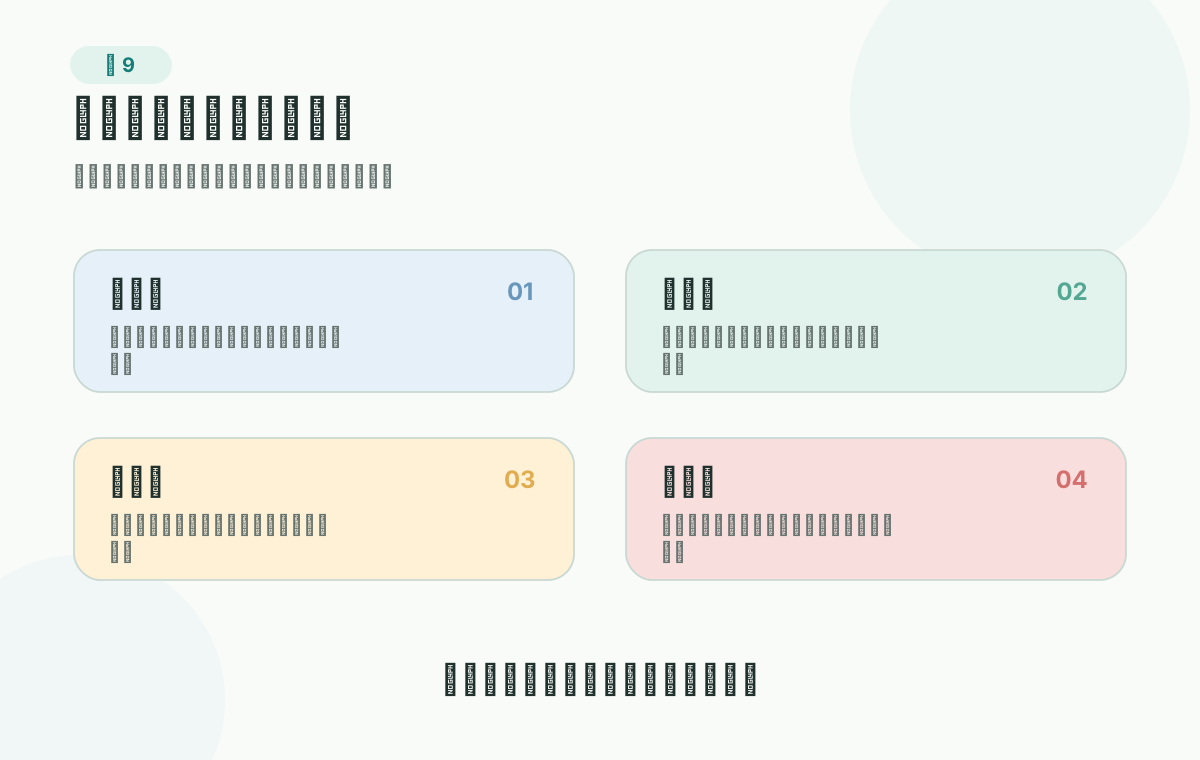
The order matters: look at safety and body first, then function and relationships; but do not look only at the body, and do not look only at relationships. Children's problems are often not single-line problems.
What Needs Managing Is The Base, Not Every Detail
When many parents say they are "managing the child's health," they unconsciously manage every detail: when to bathe, where shoes go, whether handwriting is neat, whether posture looks right, every minute of phone use, who they chat with, why the door is closed.
Some of these things need reminders, of course. But if they occupy all attention, the things that truly need managing get squeezed out.
In childhood and adolescence, what families should manage most is the health base.
First, sleep. Sleep is not leftover time after schoolwork; it is the base for growth, attention, emotion regulation, and body recovery. If children chronically do not sleep enough, many problems worsen together: daytime sleepiness, irritability, poor attention, less movement, disordered appetite, and harder stopping with screens.
Second, movement and outdoors. Movement is not only "exercise"; it is also a way for children to experience frustration, cooperation, competence, and peer connection. Instead of turning movement into another task, it is more important to help a child find a body activity they enjoy enough to repeat.
Third, food environment and weight trend. What children eat, what the household buys, and whether snacks and sweet drinks are easy to reach are largely decided by the family. This is not a place for body shaming or ridicule. What matters is the long-term trend, food pattern, physical activity, sleep, and mental state.
Fourth, basic medical care and safety boundaries. Fever, abdominal pain, headache, allergy, vision, periods, sports injury, and emotional or behavioral changes all require knowing when to observe, when to use outpatient care, and when to use urgent or emergency care. Safety cannot depend only on "the child will say something."
Fifth, gradually return agency to the child. Adolescents need to move from "the person being arranged" to "the person participating in decisions." Parents and caregivers can provide boundaries, resources, and explanations of consequences, but not every health issue should become control. If control is too detailed, children hide information; if support is too empty, children may carry risks beyond their age alone.
In U.S. care, adolescents may also need some private time with a clinician, especially around mental health, safety, sexual health, substance use, and relationship pressure. Confidentiality rules vary by state and situation, and immediate safety risks are handled differently. The practical family message is still useful: make room for the adolescent to speak directly with a professional, while keeping clear safety and follow-up boundaries.
The family principle can be simple: manage what must be managed, especially the base and red lines; leave space where control should not be too tight, especially around identity, privacy, and the autonomy that is gradually growing.
Body Line: Puberty Is Not Just "Rebellion"
Puberty cannot be summarized as "rebellion."
The body begins changing first: height, weight, body odor, body hair, voice, acne, periods, wet dreams, sexual curiosity, sensitivity to appearance. A child may be curious, embarrassed, and afraid to be seen at the same time. Early puberty, late puberty, being much taller or shorter than peers can all affect self-esteem and social life.
The mind is also reorganizing. The child begins asking more seriously: Who am I? What do I look like to others? Do I have value? Where do I belong? Can I decide some things myself?
These questions do not appear as essays. They land in clothes, hairstyles, friend groups, games, grades, interests, dating, body, privacy, and "don't manage me."
So what parents most need to avoid is managing the body with shame.
Do not mock body odor, acne, body shape, puberty timing, or appearance anxiety. Do not describe periods, wet dreams, masturbation, and sexual curiosity as dirty or frightening. Do not say "what is the big deal" while joking about the child's body changes in front of relatives and friends.
Body changes are not shameful, and body problems should not be endured silently. Menstrual pain, abnormal bleeding, sudden cycle changes, clear vision decline, persistent pain after exercise, rapid weight change, repeated headaches or abdominal pain can be recorded on a timeline and discussed with a clinician. If pain is severe, bleeding is significant, the child's state worsens, or warning signs appear, do not wait until the record is complete. The family's job is not to judge the child, but to let the child know: body problems can be spoken, embarrassing questions can be asked, and dangerous problems should not be carried alone.
Function Line: First Ask Whether Daily Life Still Works
Children's mental health is not only whether they are happy, and not only whether they have a diagnosis. For families, the more practical observation is whether a child's day can still run.
Can they still sleep? Can they get up? Can they eat? Can they go to school? Can they complete basic tasks? Can they stay connected with at least one person? Is there still something, however small, that makes them feel "I can do this"?
Adolescence naturally brings fluctuation. A child may be sensitive, awkward, peer-focused, want space, and talk less with parents for a period of time. The issue is not whether the child has emotion, but whether these changes keep dragging life function down.
NIMH's boundary guidance for children's mental health is worth borrowing: if a child's mood or behavior lasts for weeks or more, causes clear distress, or affects function at school, home, or with friends, consider seeking help; if behavior is unsafe or the child talks about harming themselves or others, seek help immediately.
In family language: do not send every emotion to a doctor, and do not keep reasoning after function has already collapsed.
WHO estimates that around one in seven adolescents aged 10-19 globally experiences a mental-health condition; depression, anxiety, and behavioral disorders are among important causes of illness and disability in adolescents. These data are not meant to frighten parents. They remind us that children's mental difficulty is not "making a big deal out of nothing," and not a rare accident only in other families.
Body And Stress Often Speak To Each Other
Many children's psychological stress does not first say, "I am anxious" or "I am depressed." It may first become body and behavior.
A child has stomach pain every Monday morning, and tests do not find a clear cause. Adults easily say, "You just don't want to go to school." A better question is: when does the pain appear? Does it appear on weekends? Have eating, bowel movements, fever, weight, and sleep changed? Which step is hardest: entering the school gate, entering the classroom, seeing classmates, or taking a certain class?
This does not mean abdominal pain is psychological. Abdominal pain should be evaluated as abdominal pain; headache as headache; periods, allergy, vision problems, infection, anemia, thyroid disease, medications, and chronic illness can all affect the state. The body line should never be skipped.
But if body symptoms, mood, and life function change together, it is not enough to say "tests were fine" or "they are just not trying." Stress can show itself through sleep, appetite, gastrointestinal response, muscle tension, and autonomic nervous-system response. A child not being able to explain clearly does not mean the body is not suffering; no clear explanation on testing so far does not mean the child is pretending.
The family can do one very plain thing first: put symptoms back onto a timeline. When did it start? What time of day is it most obvious? Is it related to school, exams, peer conflict, family arguments, insufficient sleep, online events? What is the child's own explanation? Are there warning signs?
That timeline is more useful than the sentence "What is wrong with you?"
The Phone Is Not The Only Cause, But Often It Is A Stress Outlet
Phones, games, and short videos can certainly create problems: sleep gets squeezed out, attention is fragmented, outdoor activity decreases, eyes get tired, sitting and head-down posture increase, and online conflict, cyberbullying, sexual or violent content, spending, privacy risk, and dangerous challenges can appear.
But if parents attribute every problem to the phone, they often miss the real entrance.
The child may not refuse school because of the phone; school may feel so painful that the phone becomes the only place to escape. The child may not lack motivation because of games; real life may have long lacked competence, belonging, and small tasks they can bear. The child may not be irritable because of short videos; sleep loss, body tension, family conflict, and peer pressure may have pushed the system into overload together.
So limiting screen use is sometimes necessary, but it cannot be the only move. If you only take away the phone and do not add sleep, movement, peers, interests, competence, and a communicable relationship, the child may simply continue suffering in another form.
A better split is five questions.
First, is the phone displacing sleep? Second, is it affecting school, meals, movement, homework, and family interaction? Third, is the content dangerous, such as cyberbullying, pornography, violence, scams, dangerous challenges, or extremist content? Fourth, is online connection helping the child connect, or making them more isolated and anxious? Fifth, is there an offline alternative space: movement, friends, interests, clubs, outdoors, or an adult who sees more than grades?
If there is no alternative space, simple phone control becomes a war of attrition.
Relationship Line: A Child Needs More Than One Support Point
A child's health is not only in the body, and not only in the family.
A child who does not want to go to school may be falling behind academically, but may also be isolated, mocked, bullied, in conflict with a teacher, afraid of tests, afraid of speaking in class, or afraid of part of the route to school.
A child who suddenly becomes quiet may not be "getting well behaved"; they may have lost an important friend, been excluded from a group chat, or been humiliated online.
A child with repeated abdominal pain or headache may truly need pediatric evaluation; it may also be more obvious before school, which suggests the body is saying, "I cannot hold this."
CDC materials on youth mental health emphasize that connectedness at school, in family, with friends, and in the community is an important protective factor for adolescents. In family language, a child needs more than one support point.
That support point can be a parent, but it can also be a relative, teacher, school nurse, school counselor, coach, therapist, friend's parent, sports team, interest group, or community activity. Many children have only family and school in daily life, and both places are full of evaluation. So phones, games, online groups, and virtual identities become the third space they find themselves.
A third space does not mean parents stop caring. Safety, money, adult boundaries, online privacy, and time still need attention. But if a child only has places where they are checked and evaluated, and no place to release, try, be accepted by peers, and feel valuable, the mental system becomes very narrow.
How To Talk With A Child About Health
Many parents and caregivers care deeply, but as soon as they speak, it sounds like interrogation.
"Why won't you go to school?"
"Why are you always on your phone?"
"What is wrong with you?"
"Are you depressed?"
"Who bullied you?"
The worry behind these questions is real, but what the child hears is often judgment. Replace "why" with "which step."
For example, instead of asking "Why won't you go to school?" ask: "Waking up, leaving home, entering the school gate, entering the classroom, seeing classmates: which step is hardest?"
Instead of "Why are you always on your phone?" ask: "Which part of the phone helps you relax most? Is something in real life too hard lately?"
Instead of "What is wrong with you?" ask: "Which moment of the day has been hardest recently?"
Instead of "Who bullied you?" ask: "Has anything at school recently made you scared, embarrassed, or not want to see someone?"
If the child is willing to say a little, receive it first. Do not correct immediately. You can say: "Thank you for telling me. This sounds really hard. I will not rush to judge you. Let's first see how to make you a little safer and lighter."
If the child is not willing to speak, do not treat silence as hostility. Leave an entrance: "It is okay if you do not want to say it now. But if you feel unsafe, or have thoughts of hurting yourself, you must tell me or another trusted adult. Other things can be talked about slowly."
This is not a communication-skills performance. The health logic behind it is simple: once a child feels speaking will only bring judgment, they hide more information. Once information breaks off, body problems, mental-health risks, and school risks all become harder to notice in time.
Safety Line: Do Not Keep Guessing At Home
The following situations are not for continued observation, reasoning, or searching online.
Trouble breathing, blue lips, obvious gasping; altered consciousness, cannot be awakened, seizure without recovery, serious head injury; persistent high fever with very poor general condition, clear sleepiness, poor response; repeated vomiting, clear dehydration, cannot keep fluids down; severe abdominal pain, worsening abdominal pain, walking affected by pain, or abdominal pain with fever, vomiting, or blood in stool; sudden severe headache, or headache with facial drooping, one-sided weakness, abnormal speech, vision change, or altered consciousness; injury after which the child cannot bear weight, obvious deformity, major bleeding, suspected fracture, or serious joint injury.
Mental-health and safety red lines also exist: the child clearly says they want to die, disappear, hurt themselves, or hurt others; they have prepared tools, a place, or begun saying goodbye; self-harm has occurred; there is bullying, abuse, sexual assault, or serious threats; hallucinations, delusions, severe confusion, extreme excitement, or many hours/days without sleep with clearly abnormal behavior; a parent strongly feels "this child cannot be left alone tonight."
In these moments, family actions should be simple: do not leave the child alone, remove tools that could cause harm, find a trusted adult to stay present, and contact 911 or local emergency services, go to an emergency department or pediatric emergency department if available, contact 988 or mobile crisis support for a mental-health crisis where available, or involve school crisis staff when the risk is at school. Entry points differ by region, but the principle is the same: safety first, reasons later.
If you do not know whether this is emergency care, outpatient care, or a specialist issue, first use Care Entry And Specialist Navigation. Before an outpatient visit, use the Doctor Visit Checklist to compress the material into one page.
Record Changes For One Week
The more complex the child's problem is, the more important it is to reduce information loss. Record one week continuously. It does not need to be a long diary; just keep the key changes.
You can record when the change started, whether body symptoms, sleep, and appetite changed, whether functions such as school, homework, movement, social contact, and hygiene changed, whether mood, behavior, school or peer relationships, and family environment changed clearly. The child's own words are especially important. If online spaces and phone use involve bedtime use, group-chat conflict, privacy, spending, or tips/gifts, write that down too.
Red signals cannot wait for the record to be complete. Any self-harm, suicide, risk of harming others, risk of being harmed, running away, severe loss of control, or inability to stay safe means safety and help come first.
Bringing this record to a pediatrician or primary care clinician, adolescent medicine, eye care, gynecology, orthopedics/sports medicine, school counseling, child and adolescent mental health, or another professional entry point will be more useful than saying "their state has been bad lately." Do not solve everything at once; choose the one change that worries you most, find a low-pressure time, and ask the child one specific question without cross-examining every detail, such as "Which step of school has been hardest recently?" or "What is hardest to stop before bed?" If possible, add one more support point: outdoor activity, a trusted teacher, a relative, an interest activity, a clinician appointment, or psychological support for the parent or caregiver.
Often, children do not lack explanations; they lack an environment where they can regain safety, connection, control, and a little hope.
References
As of 2026-06-28, this chapter mainly uses WHO materials on adolescent mental health, CDC materials on youth mental health, NIMH materials on children and mental health, MedlinePlus teen health, HealthyChildren materials from the American Academy of Pediatrics, and SAMHSA 988 information to calibrate boundaries around children's and adolescents' bodies, emotions, family and school support, peer connection, care entry points, and warning signs.
These materials jointly remind us that adolescence is a stage of rapid change in body, emotions, and social relationships; healthy habits, family and school support, peer connection, timely care, and warning-sign recognition are all part of child and adolescent health.
Start directly with: WHO Adolescent mental health, CDC Youth Mental Health, NIMH Children and Mental Health, MedlinePlus Teen Health, HealthyChildren Teen, and SAMHSA 988 Suicide & Crisis Lifeline. More sources are in the source registry. This book's evidence rules are in the evidence policy.
Summary
- Child and adolescent health is not a smaller version of adult health. Physical development, communication ability, psychological tasks, school and peer context, and care entry points are different.
- Parents should first watch four lines: body, function, relationships, and safety. Do not look only at symptoms, and do not look only at behavior.
- What truly needs managing is sleep, movement, food environment, basic care, and safety boundaries, not using health as a reason to control every detail.
- Screens, school refusal, abdominal pain, headache, irritability, and silence are often signals. Do not look only at the surface behavior.
- When there are warning signs, persistent functional impairment, or safety risk, connect pediatrics, school support, child and adolescent mental health, or emergency care promptly.